
Winter care of Agapanthus
The traditional, yet misleading, view that Agapanthus are frost tender has now been proven false. This is thanks to factors such as increased knowledge of Agapanthus cultivation requirements, milder winters, and a greater range of varieties. This means that many Agapanthus can now be successfully overwintered outdoors, with a little bit of know-how.

Most evergreen Agapanthus, providing they are planted in a reasonably free-draining soil, are frost hardy to at least -5 °C. Deciduous types, which die back completely in winter, are far tougher and can withstand temperatures to at least -10 °C. That said, a useful general rule for British gardeners is to draw an artificial line across Britain between The Wash in East Anglia on the East Coast to the Severn Estuary in the South West. If you are beneath this imaginary line (the southern half of the country), you will most likely be able to grow both evergreen and deciduous types in either the garden, containers, or both with little winter protection in a typical winter. If you are above the line (the northern half), it is best to think of deciduous types as a hardy border perennial and evergreens as somewhat tender. These are best grown in pots where they can be readily protected in the coldest of winters. This is of course only a general rule. If you have a mild microclimate, live in a coastal area, or live in a city then you will be likely to have lighter frosts than someone in an exposed upland area or a frost pocket, regardless of where you are in the country.
In areas where prolonged and heavy frosts are prevalent, additional protection can be afforded to Agapanthus. If deciduous types are planted in the ground then it is advisable to cut the foliage back to about 3cm above ground level, and cover with a mulch. A simple layer of chipped bark, straw, or compost is ideal. The harder the frosts, the deeper the mulch layer is a good principle to follow; anything from 5cm to 20cm can be applied at the beginning of November, then gently brushed aside in late March as the new growth points begin to emerge.

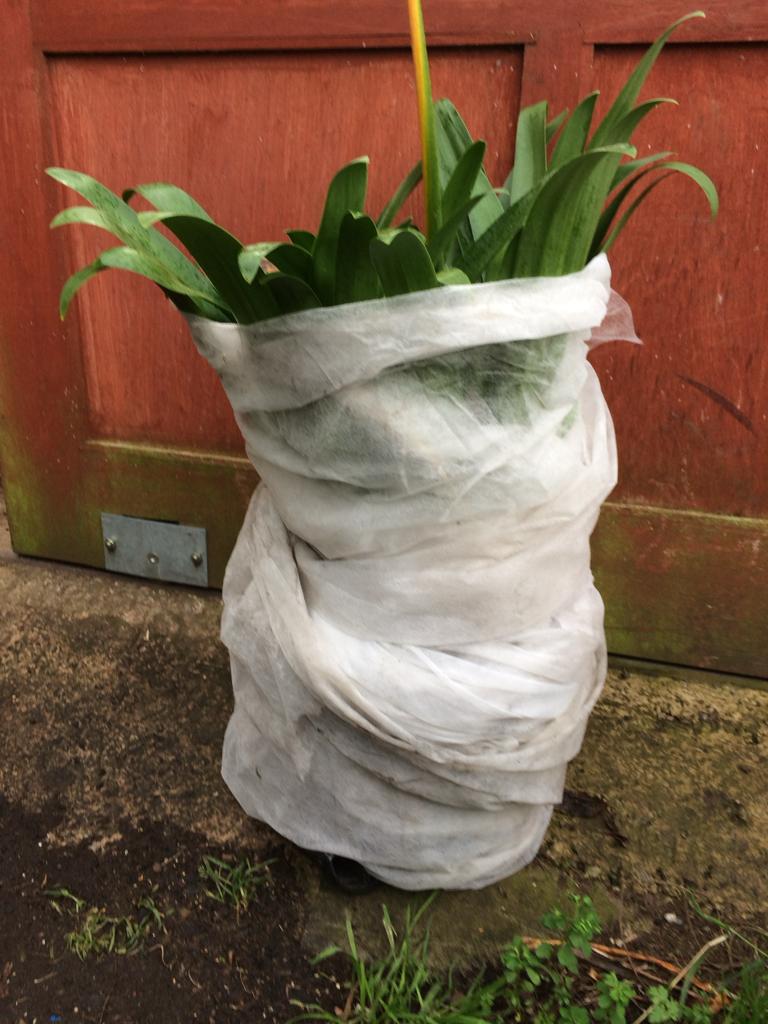
Evergreen types should be brought inside a cold glasshouse or unheated room. People often make the mistake of bringing them into the house during winter as a precaution against the frost. This might seem a good idea, but a house is usually far too warm for Agapanthus as a cool winter is required to initiate flowering. Many gardeners now simply wrap the plant, container and all, in fleece or hessian, then place it next to the house or in the lee of a sheltered wall or in a greenhouse, which usually provides sufficient winter protection.
When overwintering Agapanthus, we have found it is often worth planning for the worst whilst hoping for the best. All over Britain hard frosts have become much less frequent yet may seem to come at unpredictable times, which is often put down to global warming. Throughout the country people are giving their Agapanthus little or no winter protection. Even so, we recommend that gardeners should be willing and able to protect their plants should a harsh winter beckon. We can all be guilty of complacency which is usually is usually the midwife of disaster.